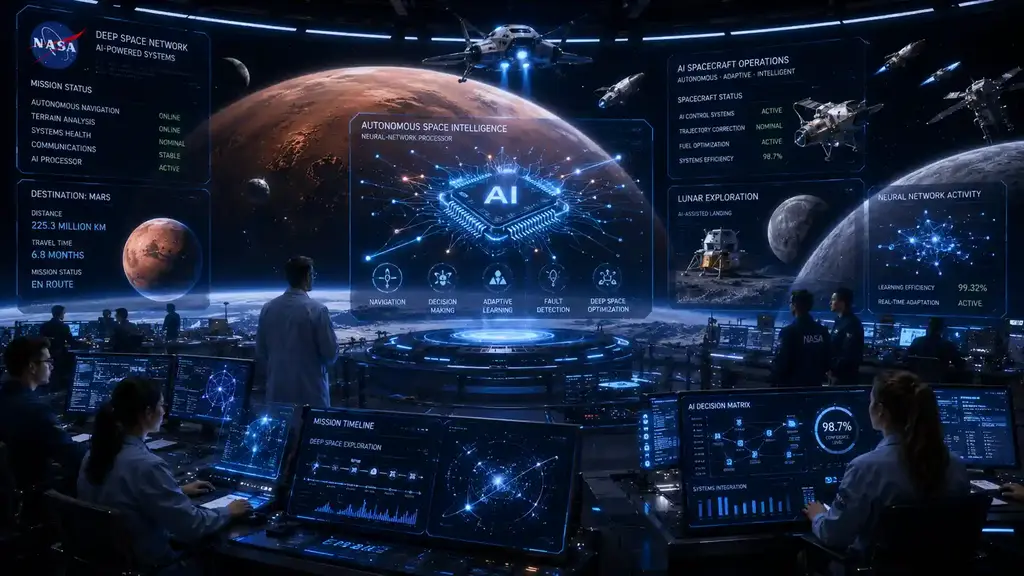


Catenaa, Sunday, May 24, 2026- NASA is testing a next-generation artificial intelligence processor capable of operating up to 500 times faster than current spaceflight computers, a breakthrough that could allow future spacecraft to make decisions independently during missions to the Moon, Mars and deep space.
The new High Performance Spaceflight Computing processor is being developed through a partnership between NASA’s Jet Propulsion Laboratory and Arizona-based Microchip Technology. The processor is designed to survive deep space radiation, violent launch shocks and extreme temperature swings while delivering far greater computing power than today’s spacecraft systems.
NASA said the chip could help future missions analyze scientific data onboard instead of waiting for instructions from Earth, reducing delays during missions operating millions of miles away.
Mission Control Shift
Current spacecraft still rely on older radiation-hardened processors because reliability has long outweighed speed in space missions. Those systems can survive harsh conditions but struggle with modern artificial intelligence tasks and high-volume data analysis.
NASA officials said the new processor marks a shift toward autonomous spacecraft operations.
The chip combines multiple computing functions into a single system-on-a-chip device small enough to fit in a human hand. It contains processing units, networking systems, memory and advanced input-output interfaces.
NASA engineers began testing the processor in February at JPL in California. The testing campaign includes radiation exposure, shock simulations and extreme thermal evaluations designed to mimic real deep space conditions.
Scientists are also using simulated planetary landing scenarios to measure how the processor handles huge streams of sensor data during high-risk descents onto other worlds.
Deep Space Ambitions
NASA said future missions will depend heavily on onboard artificial intelligence because communication delays make constant human guidance impossible during distant operations.
Signals between Earth and Mars can take more than 20 minutes each way. That delay prevents real-time intervention during emergencies or complex maneuvers.
The processor could allow spacecraft to rapidly adjust to unexpected conditions without waiting for commands from mission controllers on Earth.
NASA officials said the technology may support autonomous navigation systems, robotic science missions, AI-powered astronaut support systems and advanced communications networks.
The processor may also help future lunar bases and Mars habitats handle demanding computational workloads while operating far from Earth.
Testing Challenges
Radiation remains one of the biggest threats to spacecraft electronics. High-energy particles from the Sun and deep space can corrupt memory, trigger system failures or force spacecraft into temporary shutdown modes.
NASA said the processor has been engineered with fault-tolerant systems designed to reduce those risks.
The agency described the chip as a major leap beyond current radiation-hardened computers used aboard spacecraft and planetary probes.
Early testing results have been encouraging, according to project engineers.
NASA officials said the processor appears capable of reaching performance levels roughly 500 times greater than current spaceflight systems while maintaining stability under harsh testing conditions.
Commercial Potential
The processor is also drawing interest outside the space industry.
Microchip Technology plans to adapt the system for commercial sectors including aviation, automotive manufacturing and defense applications once development matures.
NASA has already shared early versions of the chip with aerospace and defense partners.
The project forms part of NASA’s broader push to modernize spacecraft computing as missions become more data-intensive and increasingly dependent on artificial intelligence systems.
Space agencies and private firms are preparing missions expected to generate enormous volumes of scientific information, including high-resolution planetary imaging, AI-driven robotics and real-time environmental monitoring.
Traditional spacecraft processors would struggle to handle those workloads efficiently.
Technology Race
The project also reflects growing global competition in space technology development.
Governments and private companies are investing heavily in AI-powered spacecraft systems capable of operating with minimal human supervision.
NASA said future exploration missions will require faster onboard computing to support long-duration operations in deep space.
The agency expects the processor could eventually be installed aboard Earth orbiters, planetary rovers, deep space probes and crewed spacecraft.
The processor remains under testing and has not yet been certified for operational missions.
NASA’s new AI processor could allow future spacecraft to think faster, react independently and manage complex deep space missions without waiting for instructions from Earth.




