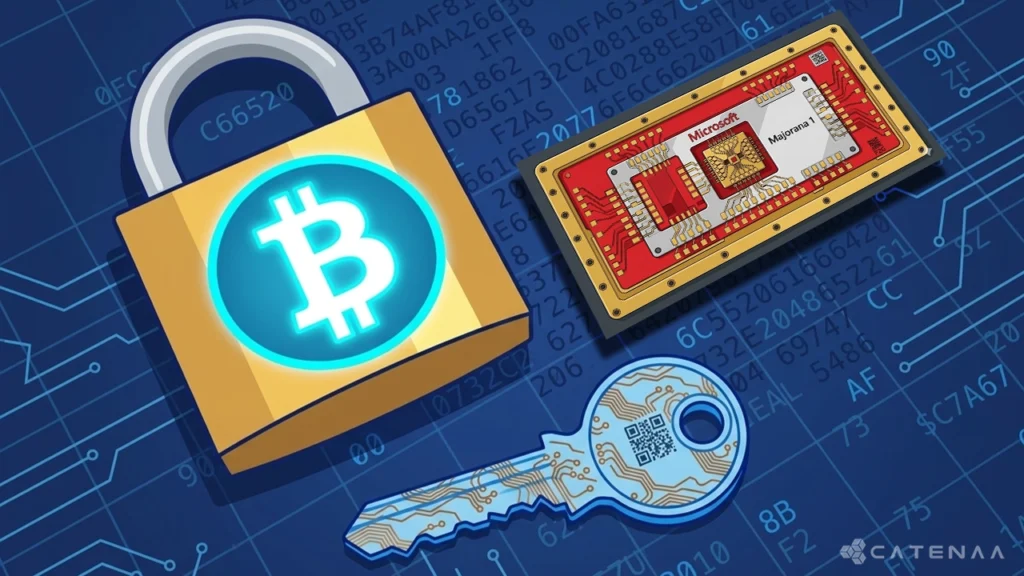


Catenaa, Tuesday, June 09, 2026- Microsoft unveiled a new quantum computing chip Tuesday that it said is 1,000 times more reliable than its previous generation, intensifying industry concerns that future quantum machines could eventually threaten the cryptographic systems securing Bitcoin and much of the global internet.
The company introduced its new Majorana 2 quantum chip during its annual Build conference, describing the technology as a major step toward scalable commercial quantum computing by 2029.
Microsoft said the chip dramatically improved qubit reliability, with average qubit lifetimes reaching roughly 20 seconds and some lasting as long as one minute.
The announcement arrives as financial institutions, blockchain developers and cybersecurity researchers increasingly warn that quantum computing progress may be accelerating faster than previously expected.
Some researchers now believe “Q-Day,” the point when quantum systems become powerful enough to break widely used public-key cryptography, could arrive within the next decade.
Microsoft said artificial intelligence played a major role in accelerating the company’s quantum research progress.
According to the company, AI systems helped researchers analyze decades of scientific data, automate quantum measurements, optimize manufacturing processes and identify materials capable of improving qubit stability.
The company’s Microsoft Discovery platform and agentic AI systems also reportedly helped scientists detect manufacturing flaws and streamline experimentation across multiple research teams.
Majorana 2 builds on Microsoft’s earlier Majorana 1 chip by replacing aluminum-based superconductors with a lead-based design that better protects qubits from external interference.
The company said the redesign significantly improved reliability, speed and scalability.
Microsoft executives argued the technology brings practical quantum computing much closer to commercial reality.
The company now expects scalable quantum systems could emerge before the end of the decade if current development trends continue.
The announcement renewed concerns surrounding Bitcoin’s long-term vulnerability to quantum attacks.
Bitcoin relies heavily on elliptic-curve cryptography to secure wallets and authorize transactions.
A sufficiently advanced quantum computer could theoretically derive private keys from exposed public keys, allowing attackers to steal funds or forge transactions.
Several industry studies estimate that hundreds of billions of dollars worth of Bitcoin could become vulnerable if quantum-capable attackers emerge before the network transitions to quantum-resistant security systems.
Recent research suggested approximately $461 billion worth of bitcoin may currently face exposure due to publicly visible cryptographic signatures.
Security researchers increasingly warn that blockchains using older cryptographic models may face particularly severe challenges during a future quantum transition.
Some analysts believe Ethereum may adapt more quickly than Bitcoin due to differences in governance structures and developer coordination.
A recent research note from Citi argued Bitcoin could face greater long-term quantum risk because the network’s decentralized governance often slows major protocol upgrades.
Ethereum’s developer ecosystem historically implemented more aggressive technical changes, including its transition from proof-of-work mining to proof-of-stake validation.
That flexibility could potentially help Ethereum adopt post-quantum cryptography faster than Bitcoin if quantum threats accelerate.
However, researchers stressed that nearly all major blockchain networks currently rely on cryptographic systems that remain theoretically vulnerable to sufficiently advanced quantum computers.
Quantum computing timelines have shortened rapidly over the past two years.
Google previously estimated that Q-Day could arrive by roughly 2032, while some researchers now believe meaningful attacks may become possible by 2030.
Recent studies from Caltech also suggested that breaking elliptic-curve cryptography may require fewer quantum resources than earlier estimates predicted.
Microsoft is not alone in reporting major progress.
Google’s Willow quantum chip reportedly achieved major reductions in quantum error rates last year, while multiple research groups continue competing to improve scalability and qubit stability.
Artificial intelligence increasingly accelerates that competition by allowing researchers to process enormous amounts of scientific data and automate highly complex optimization tasks.
Blockchain developers have already begun discussing potential migration paths toward quantum-resistant cryptographic systems.
Several quantum security firms warned the crypto industry remains dangerously underprepared for the scale of infrastructure changes eventually required.
Transitioning major blockchain networks toward post-quantum security standards would likely require large software upgrades, wallet migrations and coordination across exchanges, custodians and developers.
Analysts warned the process could take years.
The challenge becomes more difficult because some older Bitcoin wallets already exposed public keys directly onto the blockchain, potentially making them easier future targets if quantum attacks become practical.
For now, most researchers believe large-scale quantum attacks remain years away rather than an immediate threat.
However, Microsoft’s latest breakthrough reinforced growing concerns that the race between quantum computing progress and quantum-resistant cybersecurity upgrades is accelerating.
The implications extend far beyond cryptocurrency.
Modern internet security, banking systems, military communications and global financial infrastructure all depend heavily on forms of cryptography potentially vulnerable to advanced quantum systems.
Governments, technology companies and cybersecurity agencies worldwide are already investing heavily in post-quantum encryption research to prepare for future threats.
The crypto industry may ultimately become one of the earliest sectors forced to confront those changes publicly because blockchain systems remain permanently transparent and heavily dependent on digital signatures.
As quantum research accelerates, investors and developers are increasingly watching whether the industry can upgrade its security foundations before quantum capabilities reach dangerous thresholds.




