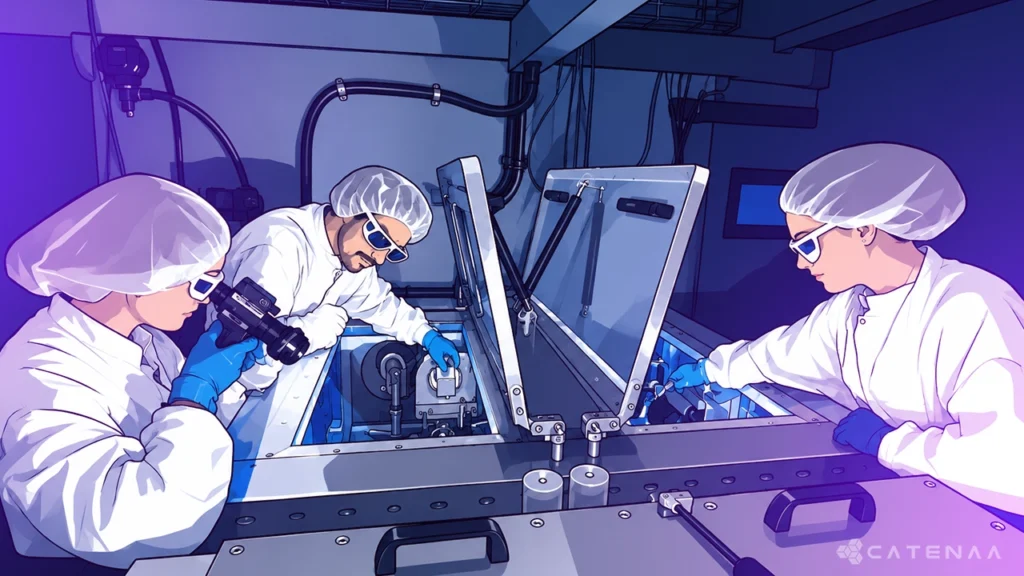


Catenaa, Sunday, May 24, 2026- Scientists have used artificial intelligence to dramatically accelerate simulations involving ultrafast lasers, cutting processing times by more than 250 times and potentially opening the door to faster advances in medical imaging, semiconductor manufacturing and next-generation communications systems.
Researchers presented the breakthrough through SPIE, describing how AI-based models can replace traditionally slow physics simulations used to study ultrafast laser behavior.
Ultrafast lasers generate pulses lasting only femtoseconds, or quadrillionths of a second, making them among the fastest tools used in modern science and engineering.
These systems are widely used in precision manufacturing, high-speed electronics, quantum research and advanced medical technologies.
Simulation Bottleneck
Accurately modeling ultrafast laser interactions normally requires massive computing power and long simulation times.
Researchers said conventional methods can take hours or even days because they must calculate extremely complex physical interactions frame by frame.
The new AI-driven approach sharply reduces those workloads by training machine-learning systems to predict laser behavior without solving every physical equation repeatedly.
Scientists said the AI models maintained strong accuracy while dramatically reducing computation time.
Faster Innovation Expected
Researchers believe the speed improvement could help scientists design and test new laser systems much faster than before.
The acceleration may also support faster development of photonics technologies, optical chips and high-speed communication systems increasingly used in artificial intelligence infrastructure and data centers.
Medical researchers could also benefit through improved laser-assisted imaging and surgical technologies.
Industry analysts say AI-assisted scientific simulation is becoming one of the fastest-growing areas inside advanced computing.
AI Expands Into Science
The project reflects a broader shift toward using artificial intelligence not only for consumer applications but also for scientific research and industrial engineering.
Technology companies and research laboratories are increasingly applying AI to chemistry, climate modeling, drug discovery and advanced materials science.
Scientists said combining AI with photonics and laser research may allow researchers to study physical processes previously too expensive or time-consuming to simulate at scale.
Researchers are now expected to test whether the same AI techniques can accelerate other high-complexity physics simulations.




